
Was ist der Body-Mass-Index (BMI)?
Der BMI ist ein einfacher Messwert zur Bewertung des Gewichts im Verhältnis zur Körpergröße.
Er berechnet sich aus Gewicht durch Größe zum Quadrat. Er unterscheidet jedoch nicht direkt zwischen Fett- und Muskelmasse.
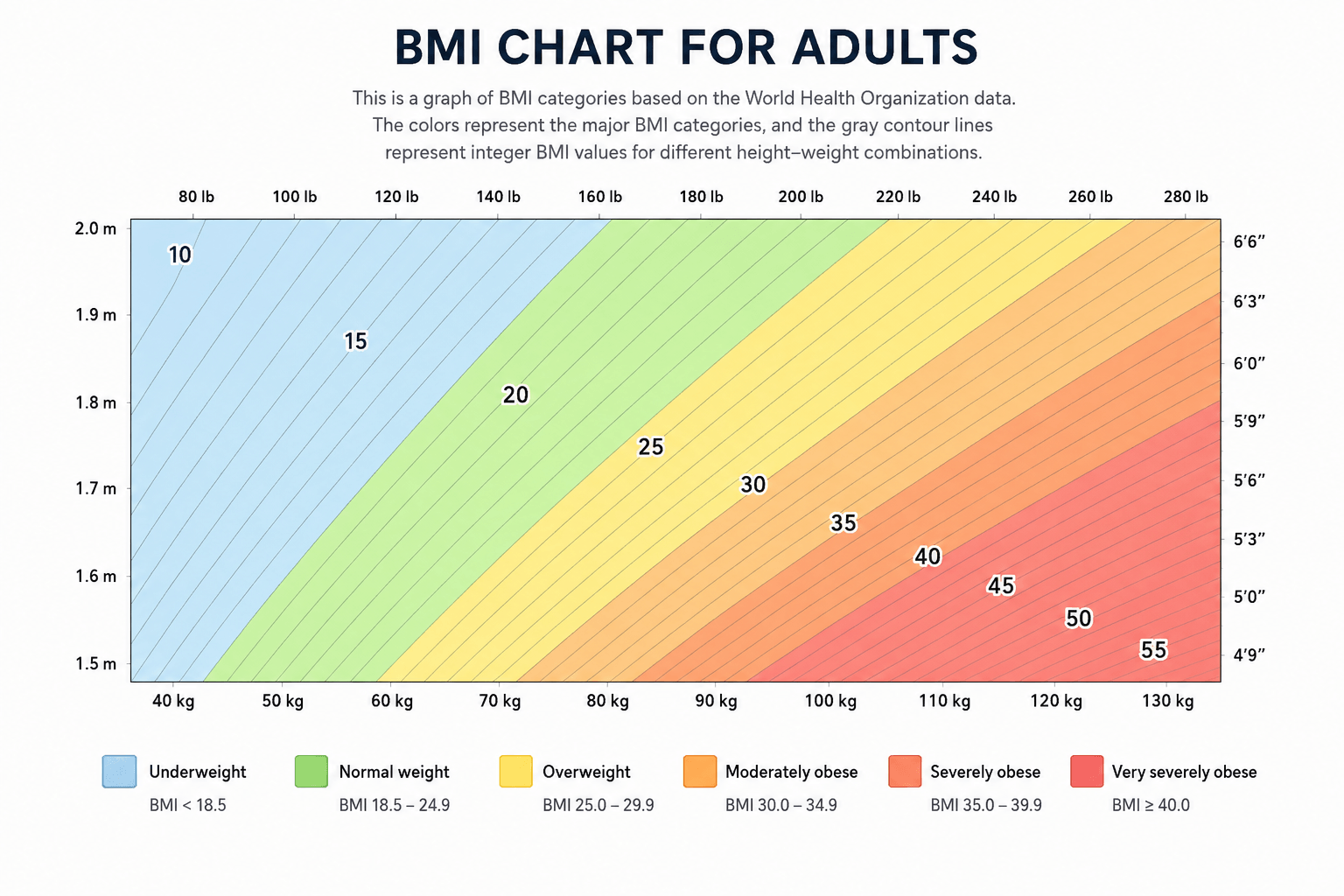
WHO BMI-Tabelle für Erwachsene
Standards der Weltgesundheitsorganisation ab 20 Jahren.
| Klassifikation | BMI-Bereich (kg/m²) |
|---|---|
| Starkes Untergewicht | < 16.0 |
| Mäßiges Untergewicht | 16.0 - 16.9 |
| Leichtes Untergewicht | 17.0 - 18.4 |
| Normalgewicht | 18.5 - 24.9 |
| Übergewicht (Präadipositas) | 25.0 - 29.9 |
| Adipositas Grad I | 30.0 - 34.9 |
| Adipositas Grad II | 35.0 - 39.9 |
| Adipositas Grad III | ≥ 40.0 |
BMI table for children and teens, age 2-20
The Centers for Disease Control and Prevention (CDC) recommends BMI categorization for children and teens between age 2 and 20 based on age-specific percentiles.
| Category | Percentile Range |
|---|---|
| Underweight | < 5% |
| Healthy weight | 5% - 85% |
| At risk of overweight | 85% - 95% |
| Overweight | > 95% |
BMI chart for children and teens, age 2-20
The Centers for Disease Control and Prevention (CDC) BMI-for-age percentiles growth charts.
BMI = 703 ×
mass (lbs)height2 (in)
BMI =
mass (kg)height2 (m)
BMI prime =
BMI25
| Klassifikation | BMI | BMI Prime |
|---|---|---|
| Starkes Untergewicht | < 16 | < 0.64 |
| Mäßiges Untergewicht | 16 - 17 | 0.64 - 0.68 |
| Normalgewicht | 18.5 - 25 | 0.74 - 1 |
| Übergewicht (Präadipositas) | 25 - 30 | 1 - 1.2 |
| > 30 | > 1.2 |
PI =
height (in)√3 mass (lbs)
PI =
mass (kg)height3 (m)
Häufig gestellte Fragen (FAQ)
F: Was ist ein gesunder BMI?
A: Nach WHO-Standards gilt ein Wert von 18,5 bis 24,9 als gesund.
F: Ist der BMI für jeden genau?
A: Es ist ein Richtwert. Bei Sportlern mit hoher Muskelmasse kann er verfälscht sein.