

Understanding your Body Mass Index (BMI) is an essential first step toward evaluating your overall wellness, body composition, and physical health baseline.
What is Body Mass Index (BMI)?
Body Mass Index (BMI) is a simple, globally recognized mathematical tool used to assess a person's weight relative to their height. The goal is to provide a general estimation of tissue mass (fat, muscle, and bone) and determine whether current weight falls within a healthy range.
It is calculated by dividing weight in kilograms by the square of height in meters. While a useful tool, it does not directly measure body fat or muscle distribution. However, it remains a valuable primary indicator for screening health risks.
WHO Adult BMI Classification Table
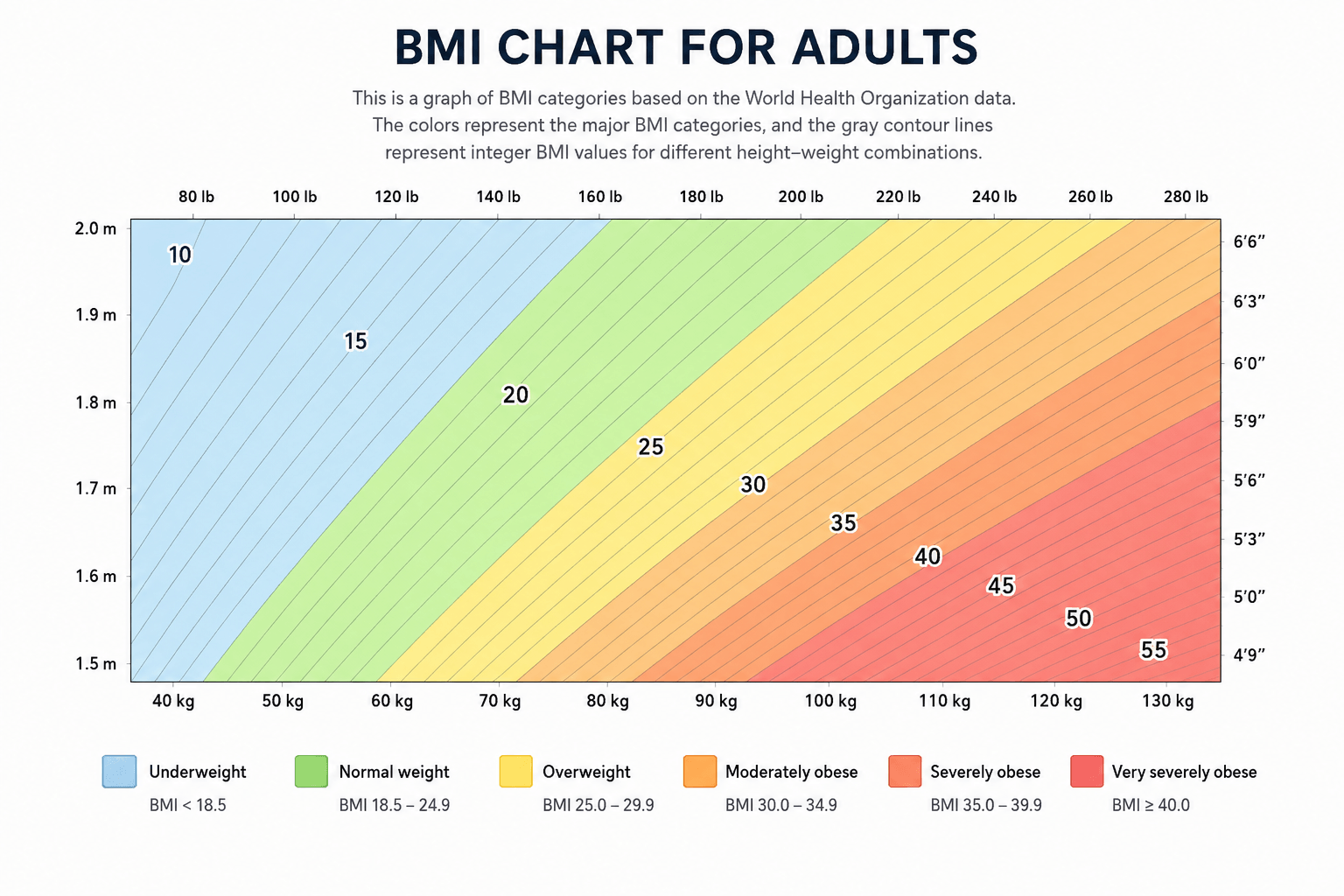
Standard classifications approved by the World Health Organization (WHO) for adults aged 20 and older:
| Classification | BMI Range (kg/m²) |
|---|---|
| Severe Thinness | < 16.0 |
| Moderate Thinness | 16.0 - 16.9 |
| Mild Thinness | 17.0 - 18.4 |
| Normal Weight | 18.5 - 24.9 |
| Overweight (Pre-obese) | 25.0 - 29.9 |
| Obesity Class I | 30.0 - 34.9 |
| Obesity Class II | 35.0 - 39.9 |
| Severe Obesity (Class III) | ≥ 40.0 |
BMI Visual Chart for Adults
BMI table for children and teens, age 2-20
The Centers for Disease Control and Prevention (CDC) recommends BMI categorization for children and teens between age 2 and 20 based on age-specific percentiles.
| Category | Percentile Range |
|---|---|
| Underweight | < 5% |
| Healthy weight | 5% - 85% |
| At risk of overweight | 85% - 95% |
| Overweight | > 95% |
BMI chart for children and teens, age 2-20
The Centers for Disease Control and Prevention (CDC) BMI-for-age percentiles growth charts.
Risks Associated with Being Overweight
Carrying excess weight can place additional stress on vital organs and system functions, increasing long-term health risks such as:
- High blood pressure and cardiovascular strain.
- Increased risk of Type 2 Diabetes and insulin resistance.
- Elevated risk of joint pain and osteoarthritis.
- Higher likelihood of sleep apnea and respiratory difficulties.
Risks Associated with Being Underweight
Maintaining a weight significantly below the recommended range can also present health concerns, including:
- Nutritional deficiencies and vitamin deficiencies.
- Weakened immune system responsiveness.
- Potential bone density loss or osteoporosis.
- Fatigue and impaired physical stamina.
BMI Formula & Calculation Methods
BMI can be calculated using standard metric parameters or imperial US customary measurements:
US Customary Units
Metric SI Units
Understanding BMI Prime
BMI Prime is a variation of the standard BMI measurement system that compares an individual's BMI to the upper limit of normal BMI (25 kg/m²).
| Classification | BMI | BMI Prime |
|---|---|---|
| Severe Thinness | < 16 | < 0.64 |
| Moderate Thinness | 16 - 17 | 0.64 - 0.68 |
| Normal Weight | 18.5 - 25 | 0.74 - 1 |
| Overweight (Pre-obese) | 25 - 30 | 1 - 1.2 |
| Obesity Class | > 30 | > 1.2 |
Understanding Ponderal Index (PI)
The Ponderal Index measures body corpulence similarly to BMI, but accounts for height raised to the third power, providing better scaling for taller or shorter individuals.
US Customary Units
Metric SI Units
Frequently Asked Questions About BMI
Q: What is a normal and healthy BMI range?
A: According to WHO standards, a BMI between 18.5 and 24.9 is considered normal and healthy for most adults.
Q: Is the BMI calculator 100% accurate for everyone?
A: Not always. BMI does not distinguish between muscle mass and fat mass. Athletic individuals with high muscle mass may record a high BMI despite having very low body fat.